
Riverbank Previous Residents by Record Era
An address changes meaning across record sets. A current assessment record can identify the parcel, but an owner is not automatically an occupant. A deed records a transfer, while a directory records a listed person or subscriber. Census schedules describe households for public years, and a permit may show an applicant without proving residence. For a Riverbank house history involving previous residents, keep these evidence types in separate columns. The strongest trail is a chain of matching parcel identity, names, dates, and addresses, not a single result.
| Source | Years It Covers | Where Held | What It Shows |
|---|---|---|---|
| RecorderWorks index | 1850-current index claim | Online; Stanislaus Clerk-Recorder | Indexed parties, type, date, locator, APN or legal description when present |
| Recorder office books and film | 1978-current electronic work; 1920-1988 G/G; to 1853 film or fiche | Public terminals in Modesto | Images, book/page trail, and older index references |
| Polk directories | 1910-1991; Riverbank inclusion confirmed for 1958-60 | Modesto Main Library Special Collections | Names, addresses, and household leads |
| Haines criss-cross | 1971-1990; catalog carries an odd 1993 gap note | Modesto Main Library Special Collections | Street-to-listed-occupant and telephone leads |
| County telephone directories | 1966-1998 | Special Collections | Subscriber and address trail |
| Federal census | Through 1950 under the 72-year rule | NARA, FamilySearch, or library access | Household names, ages, and relationships |
| Riverbank permits and planning files | Coverage start not published | Development Services counter or request | Work, inspections, applicants, and project dates |
Start with the newest anchor. For ownership, use the assessor or a known APN, then move to RecorderWorks. For occupancy, use Haines for an address-first lead, then compare Polk and telephone volumes. Early Stanislaus directories from 1871-1891 predate Riverbank's 1896 emergence, so an entry does not prove Riverbank coverage. RecorderWorks' 1850 to current statement is an index claim, not proof a Stanislaus County office existed before its 1854 organization.
The Stanislaus County Clerk-Recorder services page is the office starting point for hours, forms, official-record copy routes, and current charges.
That distinction between an index, an image, and a copy keeps a promising previous-resident lead from being mistaken for a verified deed.
Riverbank Previous Residents and Polk Gap Years
The Polk shelf offers the broadest named directory run for a Riverbank backward search for previous residents, but it is not a clean annual ladder. The collection is cataloged from 1910 to 1991, with gaps at 1923-24, 1936, 1943-45, 1947, 1949, 1951, 1955, and 1988. Riverbank inclusion is confirmed in the 1958-59 and 1959-60 Modesto/Stanislaus County issues. Use those as firm anchors, then bracket a household with the nearest available years. A blank can mean a missing volume, a move, an omission, a name change, or a death. It does not prove a house was empty.
Directory entries need a role check. A Polk name entry can lead to an address and other fields when the actual leaf and key are inspected. No public Riverbank leaf was verified, so those fields remain collection requirements, not observed facts. Haines works from the other direction: its 1971-1990 criss-cross volumes begin with street and number, then offer a listed occupant and telephone lead. The catalog oddly lists 1993 among missing years even though its nominal run ends in 1990. Save the volume label and page before carrying a name into RecorderWorks.
Note: A Riverbank-inclusive directory year is a better starting anchor than an assumed continuous run across every calendar year.
Riverbank Deeds and Past Residents
Ownership is the cleanest way to set an address timeline for previous residents, but it still needs careful language. The Assessor's anonymous Public Inquiry is APN-keyed, not a general name or street browse. Use a known parcel number, the county counter, or a parcel map to establish the starting record. The Stanislaus County Assessor Public Inquiry returns basic parcel characteristics; richer name and situs fields are available at the counter or through restricted Agency Inquiry. An owner or mailing address is a title lead, not proof of residence. Agency Inquiry is described as $300 per year for up to five users and requires registration, an agreement, and a demonstrated business need.
The Clerk-Recorder's recorded-document search instructions show the grantor, grantee, map, image, and book/page routes that make the backward trail work.
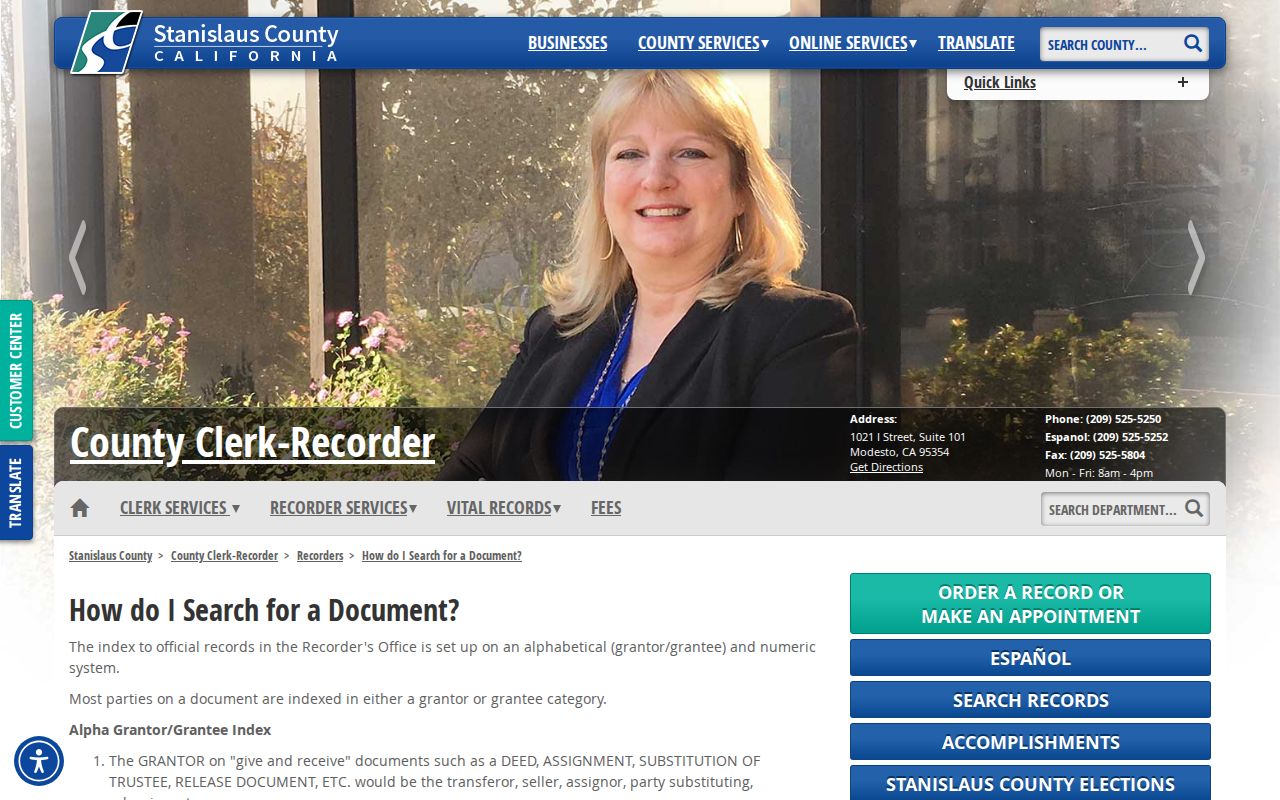
Use the recorded-document guidance as a reminder to save the locator, not just the party name; an index hit can remain useful when a free image is unavailable.
- Establish the parcel. From the assessor counter or a known APN, record owner formatting, situs, legal description, and any document number. If an address has several parcels, map each before searching names.
- Find the acquisition. In RecorderWorks, search the current owner as grantee. Match the deed by recorded date, type, APN or legal description, and seller. Save the instrument number or book/page.
- Turn the seller into the next lead. Search that seller as grantee for the earlier purchase. Repeat the seller-to-grantee step, and test trustee and trust-name variants when a trust appears.
- Change tools at the cutoff. For 1978-current material, inspect the index and available image. For older work, use the 1920-1988 alphabetic G/G index, then carry the locator to book/page volumes, microfilm, or fiche. The guide reaches to 1853, and fee-book indexes begin about 1894.
- Close the chain. Order a regular or certified copy after the locator is stable. The request form asks for the document number or book/page, type or parties, date, copies, contact details, and payment. A probate will is not a recorded deed; probate files belong with the Superior Court.
- Grantor / grantee
- The grantor transfers an interest in a deed, and the grantee receives it. Lien and judgment roles may instead reflect debtor and creditor, so check the type.
- Chain of title
- The linked transfers for one parcel, moving from the current acquisition backward through earlier sellers.
- Legal description
- Lot, block, subdivision, or metes-and-bounds wording that identifies land and is usually steadier than a street number.
- Criss-cross directory
- An address-first directory where a street and number lead to a listed person or telephone entry.
- Enumeration district
- A census area assigned to an enumerator. It helps locate a schedule when an old address is hard to read.
- Certified copy
- A copy issued by the custodian as official. An index screen or ordinary image is not automatically certified.
RecorderWorks is free online. The Clerk-Recorder also provides public workstations and inside-office ordering. The office lists 1021 I Street, Suite 101, Modesto, 209-525-5250, Monday-Friday 8:00-4:00, but check relocation notices before travel. For a remote request, use the official-record copy request form and its listed submission methods. Copies and certifications carry charges under the current Clerk-Recorder fee schedule.
Older Riverbank Deeds for Previous Residents
RecorderWorks has a deep name index, but its live range is not universal image access. The portal states 1850 through the latest posted recording date. Office guidance describes electronic index and image work from 1978 forward, a grantor/grantee run from 1920 through 1988, and microfilm or fiche back to 1853. Older instruments often require book/page or fee-book numbers, and some original books may be missing.
An in-person terminal can outperform a quick web search. Bring the legal description, APN, names, document type, and approximate recording date. Search more than one name form. If the web returns a locator without an image, preserve it and ask which volume, film, or copy route matches it. Call 209-525-5250 before a Modesto visit.
The Clerk-Recorder's recording and public inspection information describes the counter and inspection path for older records.
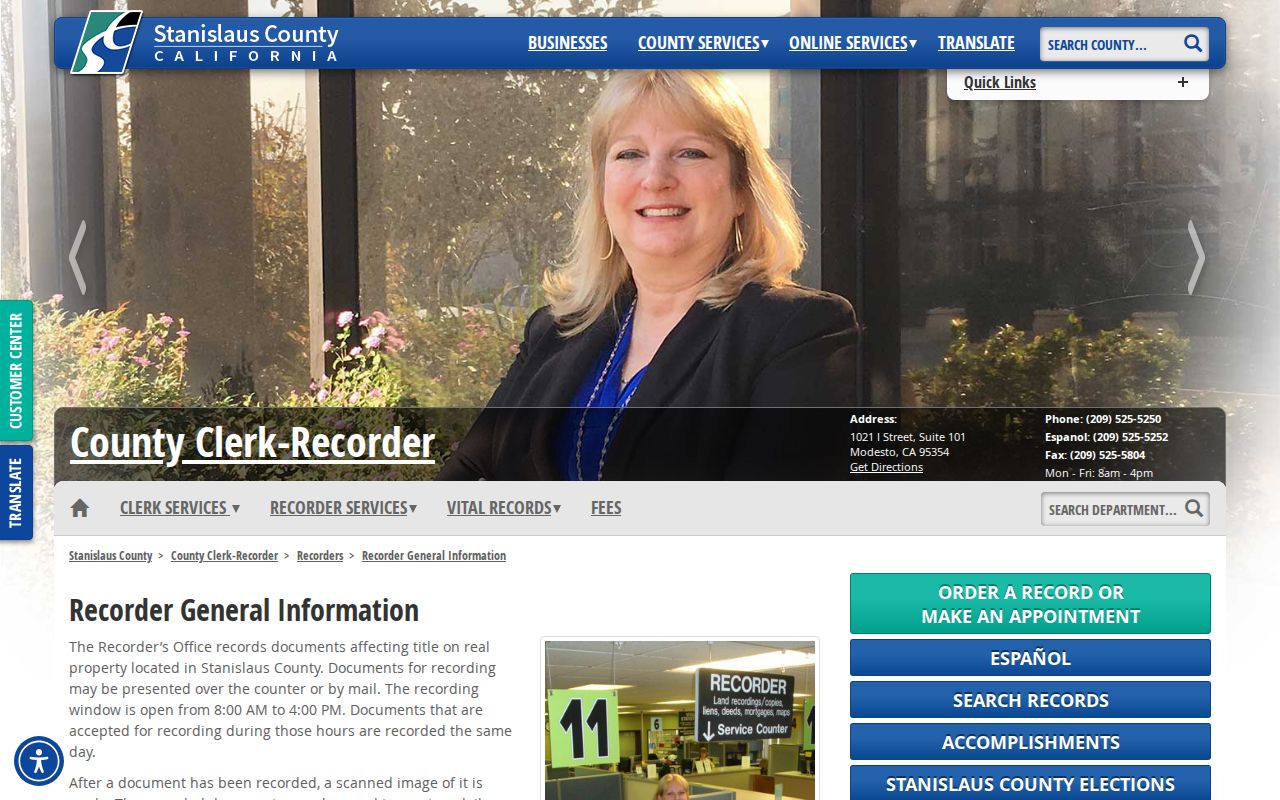
Together, the office instructions and the locator create a bridge from an online name hit to a source that can be inspected or ordered.
Counter tip. For pre-1978 Riverbank work, save the APN, legal description, and every book/page reference before asking for a film or copy.
Riverbank Address Records Need Parcel Proof
An old directory number may not map neatly to a current street label. Research did not verify a Riverbank renumbering or renaming year, so do not force a modern number backward when tracing previous residents. Compare APN history, legal description, subdivision or parcel maps, corrections, surveys, corner records, tie cards, and other recorded maps. The Stanislaus County GIS Hub shows parcel geometry, city limits, annexations, county islands, and districts. The Riverbank GIS link returned an error, so no click-to-select or radius behavior should be promised.
Keep situs, mailing, and legal descriptions distinct. Situs is the assessed property. Mailing is where assessment correspondence goes, and it may point to another residence, business, trust, PO box, or agent. The legal description is the land identity used in deeds. When these fields align with an APN and recorded map, an address-history link is stronger. When they conflict, follow the parcel or correction record instead of adding a person to the chain.
Sanborn maps can date a footprint or use when coverage exists, but no authoritative Riverbank-specific sheet or year run was found. For construction clues, the Riverbank Permit Center is the fallback. No public address-keyed permit database was located. Development Services at 6617 Third Street, 209-863-7127, receives packets in person or through its published email route. Ask for permit cards, issued permits, final inspections, planning entitlements, and code cases by address or APN. The inspection line is 209-869-6286.
Parcel bridge: modern address → APN and legal description → map or correction record → RecorderWorks locator → earlier grantor → directory and census comparison.
Riverbank Probate Records and Obituaries
A deed chain can end with a death, estate, or newspaper notice rather than another transfer. Stanislaus Superior Court is the probate custodian, and a public petition or notice may connect a decedent with heirs, devisees, a parcel, or a petitioner. RecorderWorks is not the place to find a recorded will. Keep the case number, filing date, party role, and parcel clue together before requesting a public file.
GSSC publications add probate abstracts from 1901-1911, coroner reports from 1883-1927, church registers, cemetery work, and burial permits. The NewsBank Modesto Bee collection, reached through a Stanislaus County Library card, can supply obituaries, legal notices, and address mentions. A notice is a lead, not a certified relationship. Compare its names and dates with the deed chain, directory line, and cemetery or court record.
For older material, California State Archives lists Stanislaus probate from 1854-1941 and related bonds, letters, and wills. Some series have no name index, so a remote reference question or original county-office check may be needed. The endpoint is strongest when at least two independent custodians agree on the same person and parcel.
Riverbank Library Records and House History
The 1921 Carnegie-funded Riverbank building served as the library until about 1975, later became city property, and began museum operation in 1994. That change explains why a house-history clue may move between library catalogs, museum contacts, newspapers, and family papers. The Riverbank Historical Museum at 3237 Santa Fe Street has no verified online name index, but a focused question about a street, school, family, railroad connection, or community group may identify a useful lead.
Use the building's history as context, not proof that a particular volume is held there. The county directory shelf and GSSC collection remain the documented routes. During the Modesto Main Special Collections renovation closure through September 2026, call before travel and use remote queries or digital material where available. A precise surname and date range will travel farther than a request for every record about a house.
Riverbank Previous Residents in Directories and Census
Deeds tell who transferred land, not every person listed at an address. Start with Haines for 1971-1990 when tracing previous residents. Its criss-cross format begins with a street and number, then supplies a listed occupant and telephone lead. Check the matching Polk issue alphabetically, then compare telephone books through 1998. Collection details and shelf gaps sit with the historical Riverbank directory collections. The Stanislaus County Library routes researchers to Modesto Main Library Special Collections. Riverbank Branch at 3442 Santa Fe Street, 209-869-7008, can refer questions, but the physical runs are not claimed to sit there. The room is secured during renovation through September 2026, so call before travel.
Pair each directory year with the nearest open census schedule. Federal schedules are public through 1950 under the 72-year rule. Names, ages, relationships, and address clues help distinguish people who share a surname, but they do not erase a directory gap. Use the following order:
- Choose a directory anchor. Use 1958-59 or 1959-60 for a confirmed Riverbank-inclusive Polk issue, or select a Haines year for an address-first search.
- Capture the exact entry. Save name, initials, street number, telephone, cross-reference, and the abbreviation key. Do not fill missing details from assumption; no verified Riverbank leaf was available for sample inspection.
- Pair the year. Compare the address with the 1930, 1940, or 1950 census schedule nearest to it. Read the household as a group, then compare ages and relationships.
- Check the title trail. Use APN, legal description, and RecorderWorks dates to decide whether the directory person was an owner, another listed occupant, or a same-name neighbor.
- Fill the endpoint. Search NewsBank's Modesto Bee collection through a library card for obituaries, legal notices, and address mentions. Add GSSC probate, coroner, church, cemetery, or burial-permit material when the date and county match.
Death and estate records work best as a set. Genealogical Society of Stanislaus County publications include probate abstracts from 1901-1911, coroner reports from 1883-1927, a St. Paul's Episcopal register from 1880-1921, and cemetery or burial-permit projects. The county's Superior Court is the probate custodian, and wills are not recorded in RecorderWorks. For newspaper gaps, the California State Library California History Room provides a microfilm and interlibrary-loan fallback. FamilySearch and State Archives holdings add older marriage, probate, deed, birth, and census context, although some images require sign-in, center access, or an original-office check.
The State Archives lists Stanislaus deeds from 1854-1902 and probate from 1854-1941, with some series lacking name indexes. Its research room is at 1020 O Street in Sacramento, 916-653-2246, Monday-Friday 9:30-4:00. Remote staff can identify likely series before a trip; the county office remains the check for a specific instrument.
Lawful house history. Riverbank previous-resident research is appropriate for genealogy, heir work, house history, and personal curiosity. Do not use a record to stalk, harass, track, or harm a living person, and confirm a name with the custodian before acting on it.
Note: A name match becomes useful only after parcel, date, and source roles agree in more than one record.