
Search the Riverbank Residents Directory
A strong search starts with your best clue, not the biggest database. Turn a known address into an assessor parcel number. Then follow that APN through the county roll, a recorded deed, and municipal files. Test a full name against RecorderWorks, court indexes, licenses, and business filings. Older family questions belong on the library shelf. There, Polk, Haines, telephone books, census records, obituaries, and cemetery lists overlap.
Each source answers a different question. The assessor names an owner and describes the property. The recorder ties parties to documents. The voter tool checks only the person whose identity details are submitted. A directory entry places a listed household at one moment in time. A missing name could mean a move, a death, an omission, or a lost volume. No official trail promises a roster of every adult or child at an address.
- Choose a name, address, parcel, or year as the first anchor.
- For an address, use County GIS or an assessor map to capture the APN and legal parcel identity.
- Use RecorderWorks for the owner, deed role, date, document number, book/page, or legal-description trail.
- Use California records tools only within their access rules, then compare a result with a second custodian.
- For an older household, pair a directory year with census, obituary, probate, cemetery, or church evidence.
- When a needed record is not online, name the date range, address or APN, record series, and department in a focused request.
Where Riverbank Keeps Resident Records
Riverbank is not the Stanislaus County seat. Most of the resident-record trail therefore runs to Modesto. City Hall keeps the municipal side. That includes permits, planning files, code records, and local administrative papers. The county Clerk-Recorder holds deeds and vital certificates, while the Assessor maintains the parcel roll. Elections keeps registration records and Superior Court holds case and probate files. State agencies add licenses, business entities, vital records, and confidentiality tools on top.
Stanislaus County Clerk-Recorder
1021 I Street, Suite 101
Modesto, CA 95354
209-525-5250
Stanislaus County Assessor
1010 10th Street, Suite 2400
Modesto, CA 95354
209-525-6461
Stanislaus Elections
1021 I Street, Suite 101
Modesto, CA 95354
209-525-5200
City Hall remains the local fallback for Riverbank records. The City Clerk and Elections office sits at 6707 Third Street, Suite A. Its public-records form takes a date, requester contact, department, and a reasonably specific description of the documents you want. Development Services handles permit and inspection questions at its counter. These municipal channels earn their keep when a parcel history needs a permit card, a final inspection, a planning entitlement, or a code case. Those cases have no public address search.
Riverbank's RecorderWorks Resident Trail
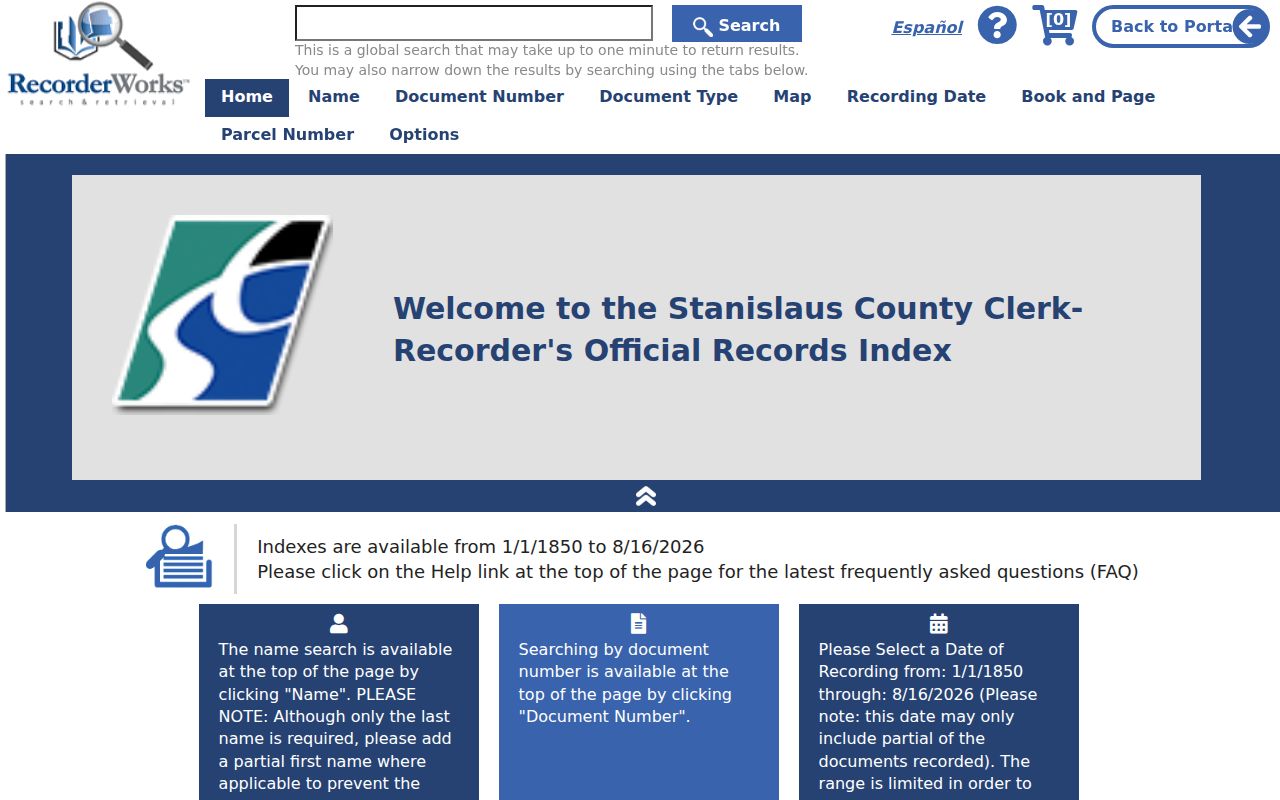
RecorderWorks is the deepest named index in the Stanislaus County portion of a Riverbank residents directory. Its public portal states an index span from January 1, 1850. It runs through the latest posted recording date. Read that as an index statement only, since the county was organized in 1854. No county office existed in 1850. Search tabs cover name, document number, document type, and map. Recording date, book and page, parcel number, and more also appear as tabs.
The name search wants LAST FIRST format and requires at least a surname. There is room for a partial match and a date range. Results can list the indexed party and role, recording date, document type, instrument number or book/page, a short description, APN or map links, and an option to order a copy. A free index is not a free image. Recorded liens also create same-name traps. So weigh the deed role, legal description, and date far more than a surname match alone.
| RecorderWorks field | How it helps a Riverbank search |
|---|---|
| Name combination | Chooses the indexed party-name combination or role. |
| Person or business name | Searches a surname and given name in the portal's format. |
| Allow Partial Match | Tests name variants without starting with a broad surname-only query. |
| From / To | Narrows by recording date in MM/DD/YYYY format. |
| Document number | Opens the locator for a selected recorded instrument. |
For older digging, save every locator you find. Office guidance describes electronic index and images from 1978 forward. An alphabetic grantor/grantee computer index covers 1920 to 1988. Book/page, microfilm, and fiche routes reach back to 1853. Before 1980, deeds normally cite book and page. From 1980 on, annual sequential instrument numbers take over, but maps keep book and page. Remember that a grantor is not always a seller. In a lien or judgment, the role can be a debtor or a defendant.
The RecorderWorks capture shows the official name-and-document route for a Riverbank residents directory search.
Riverbank APN-Gated Resident Records
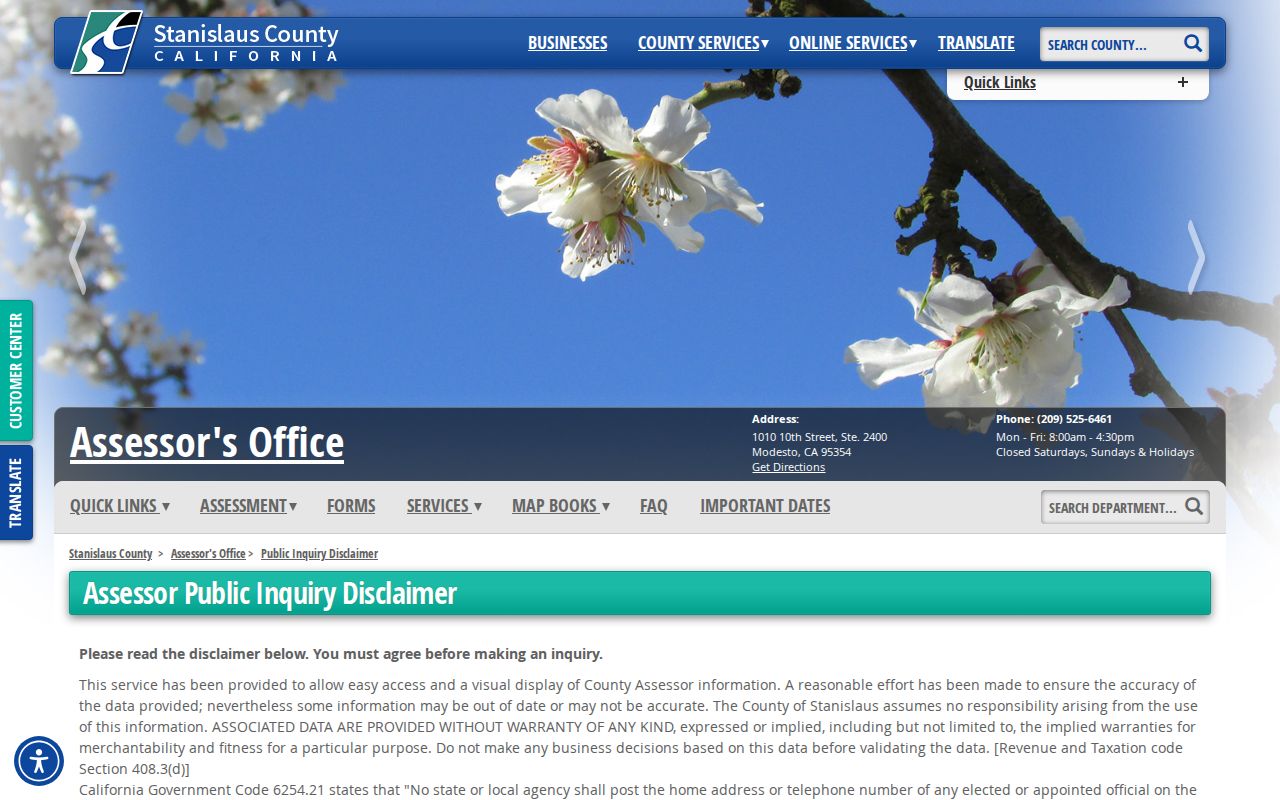
The Stanislaus County Assessor Public Inquiry carries one big limit. The anonymous web path is keyed to the APN, not to owner names or streets. After accepting the disclaimer, a researcher must have a parcel number in hand. That makes County GIS, an assessor map book, a tax parcel reference, or a known legal description the natural first steps. The counter supplies public assessment and ownership information. Richer owner-name and situs searching sits behind the restricted Agency Inquiry service or approved data products.
Keep assessor fields separate. The situs is the physical property, and the mailing address is where assessment mail goes. Neither proves the owner lives on the parcel. A parcel result can also show land and improvement characteristics. It covers values, exemptions, sales, and recorded-document numbers too. Agency Inquiry runs $300 per year for up to five users. It requires registration, an agreement, and a demonstrated business need. It is not an unrestricted people browser.
The Assessor Public Inquiry capture shows the agreement that precedes the APN-keyed property search.
Treat any current parcel result as a lead, not a verdict. Before moving on to RecorderWorks, note the APN, roll year, owner formatting, situs, mailing destination, and exemption label. Any linked document number counts too. Those details carry the ownership thread forward. The Tax Collector also runs a free search. It demands a fee parcel or APN plus a roll year. It works as a tax-account lookup rather than a name or street directory for Riverbank.
Riverbank's Current Resident Rolls
Riverbank's current directory-style sources overlap in places. None matches the full scope of a residents directory. The table separates owners, recorded parties, self-verified voters, city staff, and public organization contacts. That separation keeps a Riverbank residents directory honest, because an affiliation or a mailing address never proves where someone lives now.
| Source | Who It Lists | Keeper | Access |
|---|---|---|---|
| Assessment roll | Owner of record, parcel, situs and mailing fields | Stanislaus Assessor | APN web route; counter and restricted services |
| RecorderWorks index | Parties to deeds, liens, maps and releases | Clerk-Recorder | Free index; copies and images vary |
| My Voter Status | The person submitting identity details | California Secretary of State | Private self-lookup only |
| Riverbank staff directory | City staff by category, first name and last name | City of Riverbank | Free online search |
| Clubs and Neighborhood Watch | Public organization contacts, not member households | City and community groups | Contact and meeting information |
The Riverbank staff directory is narrow but genuine. Its Category, First Name, and Last Name fields route a public question to the City Clerk, Community Development, Police Services, or Public Works. Think of it as a small people index. For one person, use the Riverbank resident lookup page. For a single street, parcel-by-parcel work belongs on the street directory page instead.
Riverbank Voter Rules for Resident Records
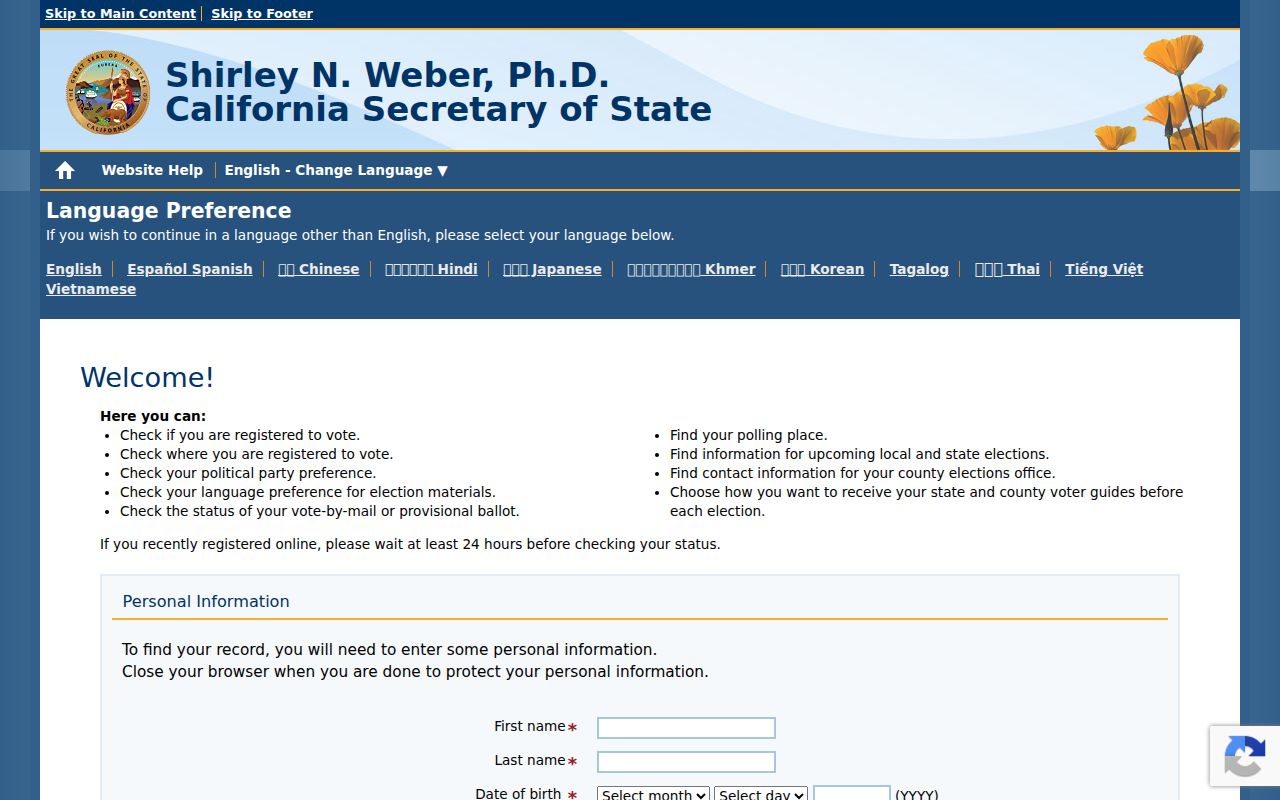
My Voter Status is the state's self-check tool. It asks for first name, last name, date of birth, and either a California driver license or ID detail or the last four digits of a Social Security number, depending on the registration. The response covers registration status, party preference, polling or election details, and vote-by-mail status. No street or ZIP listing exists there. Participation history shows whether a person took part in a named election and by what method, and it never reveals a choice.
A voter-file request works differently. California Elections Code sections 2188 and 2194 and Government Code section 7924.000 restrict release to approved election, scholarly, journalistic, political, or governmental purposes. The application itself is thorough. It records the requester, beneficiary, qualification, intended use, security plan, geography, selected fields, delivery method, identification, signature, and fee. The schedule is published. Expect seven to fourteen business days. Fees run $15 per 1,000 records with a $100 maximum, or $30 for a specific voter under the same cap. No fax or email submission is listed.
The California My Voter Status capture makes the self-lookup boundary visible: identity fields come before the result.
Riverbank Court Records and Indexes
Stanislaus Superior Court is the county path for civil, criminal, family, and probate matters. These matters touch Riverbank parties. A public web index is only a locator. The clerk and courthouse terminals open the public register of actions and any available documents. A result may list the case number, caption, case type, and filing date. It may also list parties and roles, hearings, status, disposition, and register events. Sealed, confidential, juvenile, adoption, and protected victim records are not normal public results.
Match the docket carefully. Compare the party name against an address, parcel, business, middle initial, date, or related case before trusting it. Fees are set. The court research instructions list a $15 search fee and $0.50 per page for copies. Certification runs $40. Older inactive files may sit offsite. Ordinary retrieval runs $10 with one-to-two-week service. Urgent and emergency retrievals cost $55 and $95. Mail requests need exact descriptions, return postage, and payment instructions from the clerk.
The California Courts directory routes researchers to the right court information. Federal cases use PACER. The Eastern District of California carries separate account and document charges. Neither court path replaces the recorder's deed index or the assessor's parcel roll. Those tools serve Riverbank ownership work.
The Stanislaus Superior Court route identifies the official court-search channel for Riverbank records.
Riverbank Vital Record Access
Vital records demand a different Riverbank residents directory mindset. The Stanislaus Clerk-Recorder handles county events, while California Department of Public Health Vital Records offers a statewide route plus amendments. An authorized certified copy requires a qualifying relationship and a sworn statement. Informational copies exist for many records. They carry a legend barring any use to establish identity. Adoption and confidential-marriage records stay restricted.
California keeps no single clock that opens every birth or death certificate after a set number of years. Access turns on Health and Safety Code sections 103525 and 103526, the record type, and the copy category. Pre-1905 family work needs older tools. Use county registers, church and cemetery sources, newspapers, archives, and the FamilySearch catalog. Divorce brings a choice too. A Superior Court decree differs from a CDPH Certificate of Record, which covers only divorces from 1962 through June 1984.
A county application captures the event type, names, date and place, parents or spouses, relationship, purpose, eligibility, sworn statement, signature, payment, and return address. Exact fees live in the current 2026 Clerk-Recorder schedule. Start with the county for a known Riverbank event. CDPH steps in when the California county is unknown or an amendment is required.
Riverbank ZIP 95367 Resident Geography
Riverbank's one delivery ZIP is 95367, served by the Riverbank Post Office at 6501 Third Street. USPS offers a quick address check. A postal city is not the same thing as an incorporated boundary, though. Census ZCTAs only approximate ZIP geography with whole census blocks. For the municipal question, county GIS and city-limit or annexation layers give the real answer, while the APN and legal description settle the parcel question.
That distinction matters when a Riverbank residents directory search starts from a ZIP. The city grid grew along the Santa Fe Street and rail corridor. Planning material names Downtown, Crossroads, Crossroads West, older neighborhoods, rural-residential pockets, and the former Army plant, now the Industrial Complex. A 95367 address still deserves a city-limit check. Municipal voting follows the residence and district boundary, never the postal label.
Riverbank Resident Affiliations and Contacts
A name can surface through a public affiliation without proving a home address. California's bizfile Online search shows entity names and numbers, status, formation or jurisdiction details, principal or mailing addresses, and agents for service. Filed statements and images appear where available. The address there belongs to a business relationship, an agent, or a mailing route. It is not automatically a residence.
The Riverbank staff directory works on a smaller, more local scale. Its Category, First Name, and Last Name fields lead to civic departments. Those include the City Clerk, Community Development, Police Services, and Public Works. That helps route a civic question. It is not a resident roll. Keep affiliation, parcel, and household questions separate.
The Riverbank staff-directory capture shows a city contact index rather than a household list.
The California business search capture illustrates a second kind of public affiliation record.
Riverbank Residents in Historical Directories
The strongest historical shelf belongs to the Stanislaus County Free Library. Its Special Collections Room sits inside the Modesto Main Library. The Riverbank Branch serves as a referral point rather than a guaranteed holding site. The Polk county shelf spans 1910 through 1991. Twelve years are missing from that run. Riverbank-inclusive issues are expressly confirmed for 1958-59 and 1959-60. Haines reverse directories cover 1971-1990, and county telephone books run from 1966 to 1998.
Earlier county directories from 1871-1891 predate Riverbank's 1896 emergence. So an early Stanislaus entry needs a place check before anyone labels it Riverbank. GSSC adds probate abstracts, coroner reports, and church registers. It also holds cemetery and burial-permit projects, a 1890 Great Register, veteran material, and a Tinkham history index. A family trail gets stronger when a name, address, death notice, and parcel document all agree.
The collections get fuller treatment on the Riverbank city directory collections page. Call before visiting: the Special Collections Room stays secured during renovation through September 2026. GSSC remote queries and digital material can bridge that gap.
Riverbank Family Trails in GSSC Records
Genealogy questions usually need several small indexes rather than one large Riverbank residents directory. The Genealogical Society of Stanislaus County answers queries within its own collection. It also publishes or points to probate, coroner, church, cemetery, voter, veteran, and burial-permit material. A probate abstract can identify a petitioner or heir. A cemetery permit can supply a date and place. A newspaper obituary can tie a name to relatives and a former address.
The Riverbank Historical Museum at 3237 Santa Fe Street is another local contact. Ask it about photographs, school and community material, family files, and provenance questions. The museum publishes no online name index or detailed finding aid. Its building history helps explain the scattered records. A 1921 Carnegie-funded building served as the library until about 1975. It later passed to the City. The building opened as a museum in 1994. Ask about a surname, street, school, business, railroad, or Army-plant reference. Avoid requesting an unverified roster.
Riverbank Carnegie Directory History
Riverbank's old Carnegie building teaches a local lesson in how resident evidence survives. It opened as a library in 1921, served that role until about 1975, passed to the City, and became a museum in 1994. A shelf can move while its value stays put. Library catalogs, museum contacts, newspapers, photographs, and family papers may sit in different places even when they describe the same household.
Riverbank's record history also has a clear boundary. The community emerged in 1896. A railroad division terminal arrived in 1910. Incorporation followed on August 23, 1922. Stanislaus County's official record series begin earlier, but the online RecorderWorks date of 1850 must stay labeled as an index claim. Good historical writing keeps those timelines visible instead of flattening them into one invented directory run.
Riverbank Resident Records and CPRA Requests
The California Public Records Act opens a focused path when no portal answers the question. Riverbank accepts requests by email, fax, mail, or counter delivery. It routes them through its City Clerk and Elections form. Under Government Code section 7922.535, the City has ten days to determine whether responsive records exist. That clock is only a determination period, not a promise that every record arrives within it. Fees run $0.10 per page for paper copies and $0.75 for DVDs under section 7922.530.
Be specific and save time. Name the address or APN, the date range, and the department. Also give the record series and the form you want. A permit history request might cover permit cards, issued permits, and final inspections. It could also include planning entitlements and code cases. For a deed copy, supply the RecorderWorks instrument number or book/page. Say whether a regular or certified copy is needed. The City need not assemble a new list in answer to a request for all documents. Enforcement or safety exemptions can strip portions of a file.
The Riverbank public-records form spells out the request fields and contact channels. Keep your request receipt, the response date, and any exact denial explanation. These matter whenever a records trail runs thin.
Riverbank Resident Lookup Privacy Checks
A Riverbank residents directory hit is only a lead until it survives comparison. Anchor the name to an APN. Try a legal description, a middle initial, a business, or a relative. A date or a prior address works too. Keep three roles distinct: owner, mailing addressee, and listed occupant. Plenty of household detail never becomes public. Unlisted residents, guests, and utility customers sit outside ordinary directory fields. So do DMV addresses, sealed files, confidential marriages, adoption records, and protected voters.
California's Safe at Home program gives eligible participants a substitute mailing address. It also provides confidential voter registration under Government Code sections 6205-6211. Enrollment does not erase records that already exist. A legal description can still expose property ownership. The state's 2026 DROP platform forwards deletion requests to registered data brokers. Yet it cannot touch an official deed or assessment roll. Corrections belong with the custodian who created the record in the first place.
- Roll
- An official list maintained by an agency, such as the assessment roll of parcels and values.
- Index
- A locator that points to a record; it may not include the full image or certify the facts.
- Parcel
- A defined piece of land identified by an APN and legal description.
- Criss-cross directory
- An address-first directory that can connect a street entry to a listed name or telephone, subject to its era and gaps.
Riverbank Records Compared with Compiled Tools
Commercial compiled search tools promise speed. They merge public and contributed data. Entries stale-date, or the tools fuse two people who share a name. Official custodians move slower and offer narrower access. In exchange, they provide a named source, a record date, and a correction route. Any Riverbank residents directory search gets safer once the first clue moves into the official record system. Conclusions form after that.
| Path | Strength | Limit | Best Riverbank use |
|---|---|---|---|
| Assessor or recorder | Named custodian and parcel/document locator | Owner or recorded party is not proof of occupancy | Anchor an address, APN, deed, or legal description |
| City, court, or state portal | Specific administrative or legal record context | Purpose rules, redactions, fees, and changing portals | Confirm a case, permit, license, vital event, or public contact |
| Library and GSSC | Historical household, obituary, cemetery, and directory context | Missing volumes, card gates, closure, and no universal name index | Trace past residents and family connections |
| Compiled search category | May surface a lead across several record types | Stale data, merged identities, opaque sources | Prompt an official-source check, never replace it |
Pick the tool to the question. For current ownership, start with the APN and the RecorderWorks locator. For one person, run the independent-identity workflow. For a street, treat every parcel separately. For a past household, pair the directory year with a deed, census, obituary, or probate entry, because the keyword in a Riverbank residents directory search matters less than a source trail that can actually be checked.