
Looking Up Riverbank Neighbors on a Block
Looking up Riverbank neighbors is a source-matching task, not a single search. The Stanislaus County GIS Hub gives a free map of parcel geometry, city limits, annexations, districts, and county islands. A map does not replace an assessment roll or deed. A planning notice uses a current owner list, while a personal block study can begin with one APN and move parcel by parcel. The RecorderWorks index adds parties, transfers, liens, dates, and document locators. City community pages add a meeting or Neighborhood Watch contact, not a public roster.
| Source | What It Shows About a Block | Access |
|---|---|---|
| Stanislaus County GIS Hub | Parcel geometry, boundaries, city limits, annexations, districts, county islands | Free county map and data hub; Riverbank controls unverified |
| Riverbank 300-foot owner list | Owners, mailing addresses, and APNs inside a planning notice radius | Planning application and title-company workflow |
| Stanislaus assessment roll | Owner, APN, situs and mailing addresses, values, exemptions, characteristics | Free APN search or Assessor counter; broad electronic access restricted |
| RecorderWorks | Transfers, liens, parties, dates, and document locators | Free index online; public terminals and copy request route |
| Qualified California voter file | Permitted voter fields within approved geography and purpose | Qualified request only; no open block browsing |
| City clubs and Neighborhood Watch | Public organization contacts and meetings, not member households | City list or Community Services Officer; no roster |
Each source has a different reach. An APN identifies the property record, not a person at the door. Situs names the physical parcel. Mailing shows where assessment or tax mail goes, which may be another residence, business, trust, PO box, or agent. An owner name supports a title lead, not proof of occupancy. Keep owner, mailing addressee, and any occupant clue in separate fields. That split ties a Riverbank neighbor record to what its source actually says.
Riverbank's 300-Foot Neighbor Notice Radius
Riverbank's planned-development instructions give a precise notice-radius method. For a project, the applicant obtains current owners for every parcel within 300 feet of the project perimeter. If fewer than 30 parcels fall inside, expand until at least 30 are included or the maximum 1,000 feet is reached. The package calls for a radius map, current assessment-roll copy, mailing labels and envelopes, and a title-company certification that the latest roll was used. Required fields are owner name, mailing address, and APN. The City's planned-development information is the local reference.
This circle serves owner notification, not a list of Riverbank neighbors who occupy nearby homes. The title company and roll establish notice fields, but neither proves an owner sleeps at the situs. For informal research, map adjacent parcels, inspect only needed APNs, and stop when the record stops.
Insider tip. The 300-foot circle can grow toward 30 parcels, but the 1,000-foot cap belongs to the planning notice procedure, not a general resident harvest.
Note: A formal notification list is a planning document, so its owner fields should not be recast as an occupant directory.
Riverbank GIS Starts the Neighbor Map
Start at an address, then let parcel identity set the boundary. The County GIS Hub exposes parcel geometry and layers for city limits, annexations, county islands, fire and supervisorial districts, municipal advisory councils, transport, and recorded-map references. Note the subject parcel and touching APNs, then carry them to the Assessor and RecorderWorks.
Riverbank links to a city GIS landing page, but it returned an error during inspection. Exact search fields, popup attributes, buffer controls, result limits, and neighbor-selection behavior were not verified. Pan and zoom through available county layers, record each APN, and do not promise a one-click block tool. Map geometry is a starting point, not an owner result.
- APN
- An assessor's parcel number that carries a map location into county systems.
- Situs address
- The physical address of the assessed parcel.
- Mailing address
- Where assessment or tax correspondence goes, which may be another residence, business, trust, PO box, or agent.
Mapping Riverbank Neighbors by Parcel
Once the APN is known, a neighbor lookup can follow a short chain. Keep the APN, situs, owner, mailing destination, document number, and source date together. Flow: address → parcel polygon → adjacent APNs → assessment fields → recorded owner history, with a lot kept separate from a person.
- Open the county map, locate the subject parcel, and check the city-limit or annexation layer before choosing the Riverbank boundary.
- Pan and zoom; record touching or facing APNs, keeping parcel lines separate from household assumptions.
- Run each APN through the Assessor Public Inquiry. Record the available parcel number, name, situs, ownership, mailing, values, exemptions, characteristics, sales, and document numbers.
- Take a selected owner or document number into RecorderWorks. Start with the current transfer and inspect the earlier party when needed. The index is free; images and copies vary.
- For a full named street, use the Riverbank street directory; a radius method is not a street-wide roll.
Anonymous Public Inquiry requires an APN. Owner-name, mailing-address, situs-address, exemptions, and richer characteristics are available at the counter; restricted Agency Inquiry is $300 per year for up to five users with an accepted business need and agreement.
An APN does not guarantee an online deed image. RecorderWorks states an index from January 1, 1850 through the latest posted date; electronic index and images are described from 1978, with older alphabetic, microfilm, and fiche paths. Keep the locator when an image is unavailable. Use the Clerk-Recorder's request form or a public terminal, and match document number or book/page before treating a name as a neighboring owner.
Riverbank Voter Status, Not Neighbors
California My Voter Status is narrower than a block lookup. It asks for first name, last name, date of birth, and a California DL/ID or last four SSN, depending on registration credentials. Results can show registration status, party preference, polling or election information, vote-by-mail status, and participation in a named election. Participation means whether and how a person voted, not candidate or measure choices.
The California Secretary of State registration-status route illustrates the identity-gated screen; it is not a street browser.
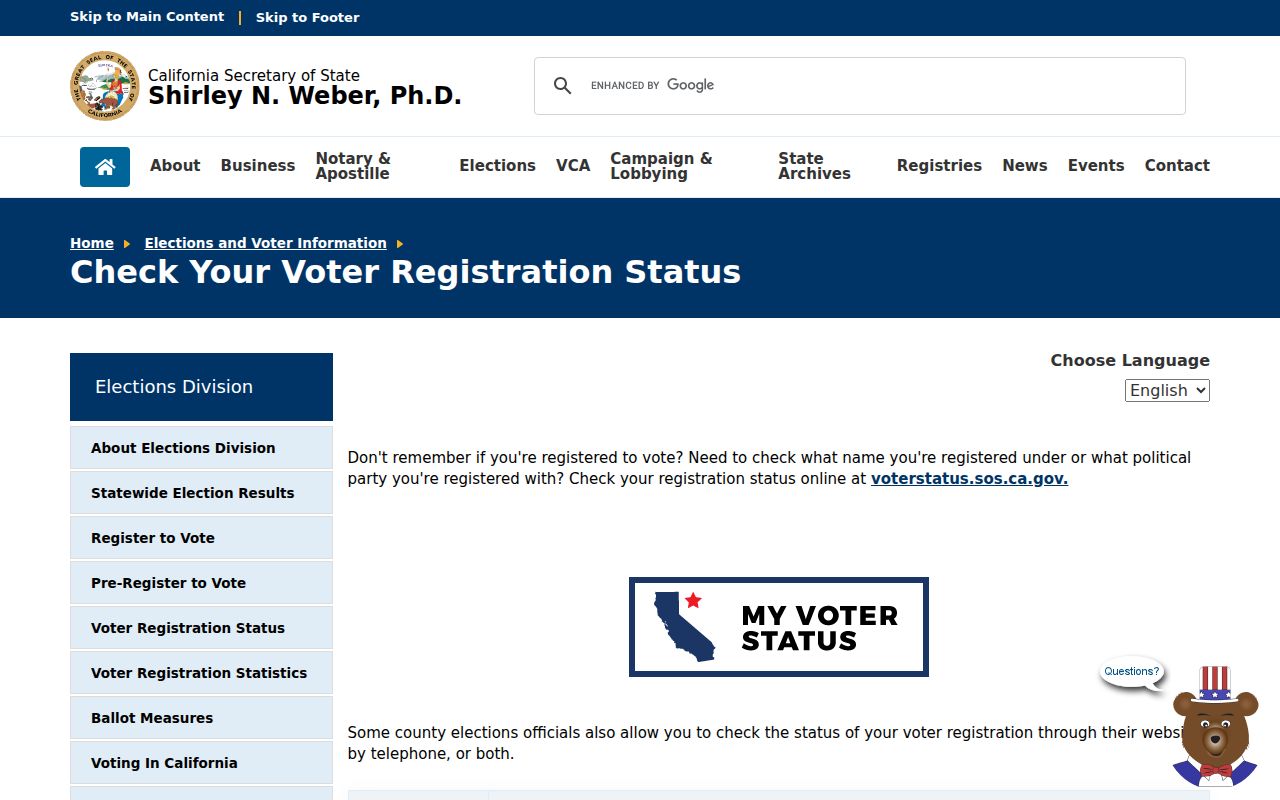
For Riverbank neighbors, the screen checks a person's registration, not an address-based block list.
| First Name | Required text field for the voter's registration identity |
|---|---|
| Last Name | Required text field for the voter's registration identity |
| Date of Birth | Required date field used with the identity check |
| California DL/ID or last four SSN | Required or conditional identity input tied to registration credentials |
| Submit or Check Status | Returns the voter's own status and election information |
Note: My Voter Status verifies the person who submits identity details; it is not an anonymous Riverbank neighbor directory.
Voter Records for Riverbank Neighbors
A qualified voter-file request is a separate channel. California allows election, scholarly, journalistic, political, or governmental uses approved by the custodian, not casual Riverbank block lists. The application asks for requester identity and contact, organization or beneficiary, qualification and purpose, security narrative, active, inactive, history, or district selections, statewide, county, or specific geography, up to ten counties or another scope, and any specified voter. Delivery can be US Mail, pickup, secure FTP, or Other. Mail or hand delivery requires current government ID, original signature, and payment; no fax or email. Processing is 7 to 14 business days. Charges are $15 per 1,000 records up to $100, or $30 per specific voter up to $100.
The state voter-file request guidance shows the qualification and delivery path a block-level question would have to meet.
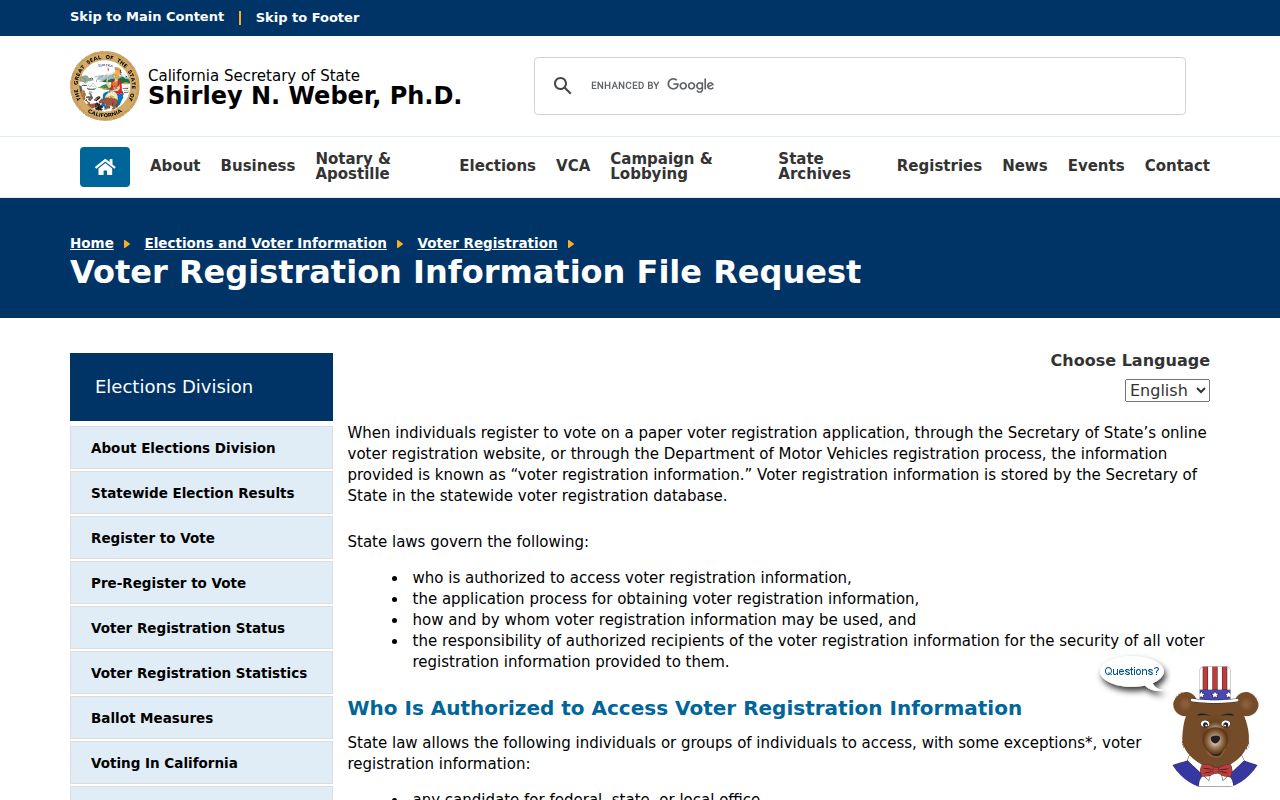
The form's identity, purpose, security, geography, and payment fields are safeguards, not search filters for ordinary neighborhood curiosity.
Stanislaus Elections, at 1021 I Street, Suite 101 in Modesto, 209-525-5200, administers county elections; Riverbank municipal elections are consolidated with the county. A qualified file may include residence or mailing address, registration date or status, precinct or district, party preference, and participation, subject to exclusions. Driver-license or ID data, last-four SSN, unique identifiers, signatures, and confidential voters are excluded.
Riverbank Neighbors and Community Contacts
Public community directories give a different kind of neighbor lead. Riverbank's city list names organizations and contact paths, not member households. That can help with a history question, a park project, a craft group, or a neighborhood meeting without turning a public contact page into a roster. Treat each group as an invitation to ask a general question, not a source for private addresses.
Riverbank Historical Society and Museum
Local photo, organization, and family-history contact. Ask about surname, street, school, business, railroad, or Army-plant material.
Riverbank Civic Groups
The list includes the Federated Woman's Club, founded 1966, Friends of Jacob Myers Park, River Valley Stitchers, Tuolumne Woodworkers Association, Royal Neighbors of America Riverbank Chapter 9890, and Riverbank Toastmasters.
Published meetings and contacts are not membership directories.
Neighborhood Watch
Police Services helps residents organize through the Community Services Officer at 209-863-7106.
Riverbank Historical Society and Museum material does not expose an online resident index or research-fee sheet. Ask for a general lead, then let the organization decide what it can share. The city page likewise supplies public meeting and contact information, not a private group-address roster. That boundary keeps community records useful for reconnecting and civic curiosity without turning volunteers or members into searchable subjects.
Official Riverbank Records vs Neighbor Tools
Official sources and commercial neighbor tools can look similar in a search result, but their evidence is not equal. Official records preserve a defined field and custodian: a parcel map, an assessment entry, a recorded document, or an approved voter file. A compiled commercial product may combine old addresses, public indexes, and inferred relationships. The comparison matters because the question is often not simply whether a name appears, but whether the name is tied to the correct parcel, time, and record type.
| Route | Useful For | Limits |
|---|---|---|
| Official GIS and Assessor | Locating an APN and checking owner or mailing fields | APN-first access; richer name and address service is restricted; owner is not occupant |
| RecorderWorks | Dated transfers, liens, parties, and document locators | Images and copies vary; names and identities still need checking |
| Approved voter channels | Confirming one's own status or making a qualified data request | No open block list; purpose and identity restrictions apply; protected fields are excluded |
| Commercial neighbor tools | Broad compiled leads assembled from mixed sources | Stale data, same-name errors, unclear occupancy, and no official custodian |
A commercial result should never outrank the APN, legal description, or official custodian. If a name conflicts, go back to the map and document number. If the purpose cannot fit a lawful personal or approved records route, stop rather than broaden the search.
Note: A paid result is not a certified copy, a current assessment roll, or proof that anyone occupies the parcel.
Riverbank Geography Shapes Neighbor Lookup
Riverbank neighbor questions also depend on geography. ZIP 95367 is the Riverbank postal city and surrounding delivery geography, while incorporated Riverbank has its own city-limit and annexation lines. The USPS Riverbank Post Office record places the facility at 6501 Third Street and shows the local 95367 service context; a postal label cannot decide whether a parcel sits inside the city. County GIS and official municipal boundary maps should answer that question.
Historic Downtown follows the grid around Santa Fe Street and the rail corridor. The Stanislaus River marks the northern context. Crossroads, Crossroads West, older neighborhoods, greenfield or rural-residential areas, and the former Army plant or Industrial Complex sit in a broader planning story. Annexations and county islands can put nearby parcels under different civic layers. For a block lookup, verify the APN and boundary layer before treating a postal match as a city match.
Riverbank Neighbor Lookup Privacy Limits
Public visibility ends well before a full household picture. Deeds identify title parties. The assessment roll identifies an owner and mailing destination. A voter file, when lawfully released, has its own approved fields. None automatically reveals unlisted occupants, household members, children, unlisted adults, guests, utility or delivery customers, DMV addresses, or a Safe at Home participant. California's Safe at Home program provides eligible participants a substitute mailing address and confidential voter registration; it does not erase information already public. Government Code §7924.000 separately protects residence street address, telephone, email, precinct or identifier, prior registration, signature, and identity numbers from ordinary CPRA release.
Elections Code §2188 and §2194, together with Government Code §7924.000, make the voter-data boundary visible in the source itself.
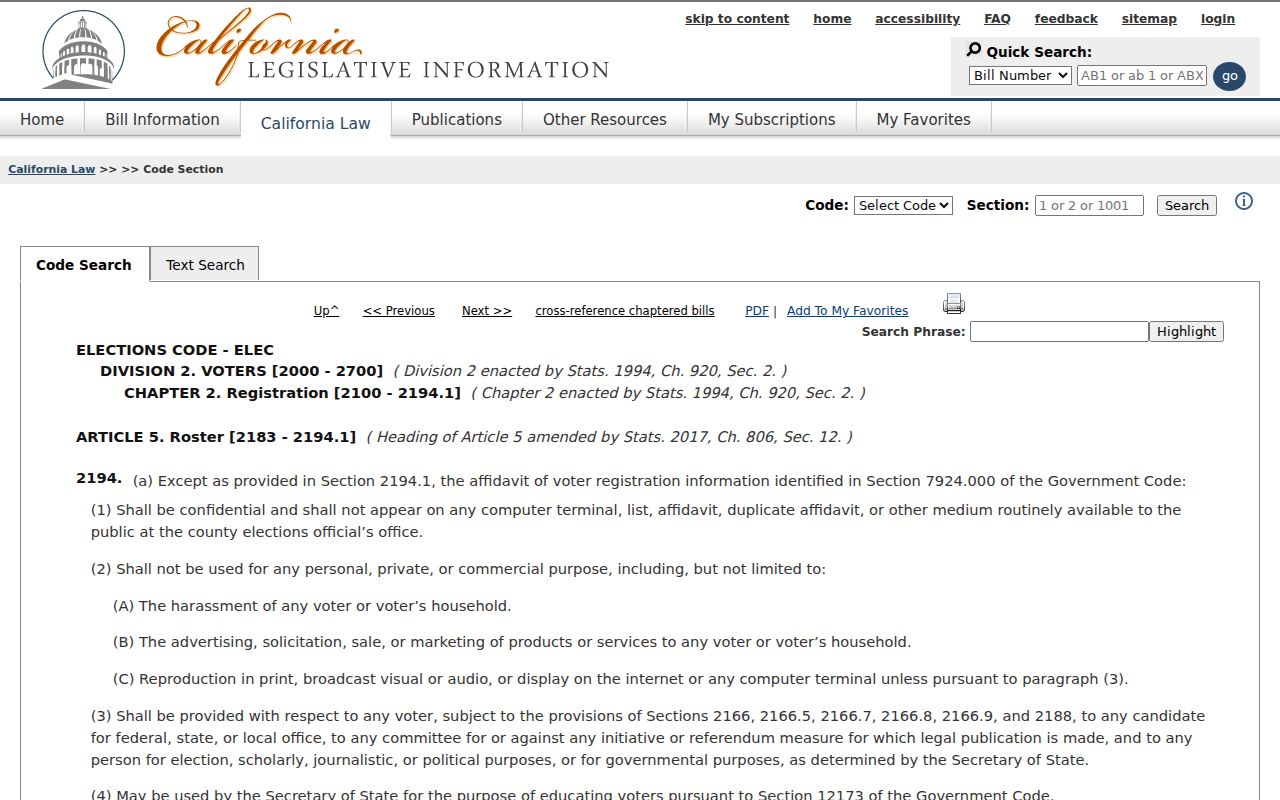
For Riverbank neighbors, the rule means that a qualified file request is still limited by purpose, exclusions, confidentiality rules, and the prohibition on misuse.
Lawful use. Use a Riverbank neighbor lookup for a lawful personal purpose such as understanding a block, reconnecting with family, or personal safety awareness. Do not use public records to watch, stalk, harass, intimidate, or harm a person.
Owner, mailing, and occupant are separate categories, and no public source should be forced to supply the missing one. A careful block study stops at that line.